Rich Tapestry
I always thought that conservative nostalgia was directed towards the 1950s – family values, social class, bad dentistry.
Apparently not. The golden age was the 11th century.
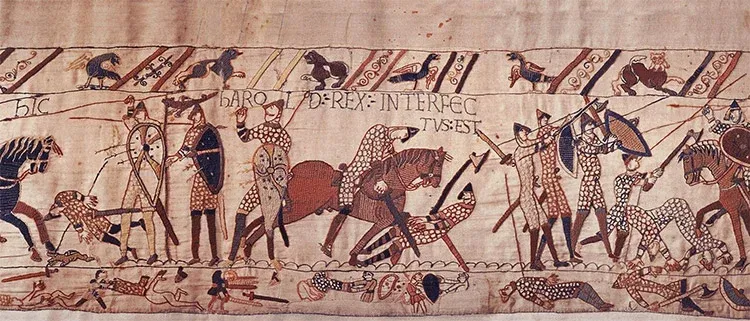
I had the radio on the other day – some rent-a-pundit panel discussion. I don’t normally listen to that sort of thing, but I was in the car, trapped. They were talking about the Bayeux Tapestry, currently on loan to the British Museum.
Huh. So we were already us before the Norman conquest. Where did that come from?
Not language – “we” were still speaking a mix of Anglo-Saxon, Old Norse, Latin and French. (Yes, French.) English had to struggle through Piers Plowman and the Canterbury Tales before it became something you would almost recognise.
Not geography. Cornwall, Cumbria, Northumbria and the Welsh Marches were not yet part of England. The capital city was Winchester.
Not dynasty. William the Conqueror was actually related to Harold’s predecessor, Edward the Confessor. (A distant cousin, but English monarchs have been imported on much flimsier pretexts.) Harold Godwinson, no relation at all, was put on the throne by a clique of Saxon nobles.
The idea that englishness was already a thing - and by implication fully-formed and set in stone - before the Normans set foot on the shingle at Pevensey is bizarre.
The truth is, we weren’t anything – a mongrel collection of oddballs and misfits, just as we are now, a different collection of oddballs and misfits. The Norman conquest was politics as usual. One bunch of entitled thugs beating up another bunch of entitled thugs, while the peasants ducked for cover. Not much has changed, give or take an arrow or two.
But now apparently this bit of history – famously written by the winners – has been hijacked by the losing side. Harold is the hero; William is a Bad Thing.
1066 And All That is alive and well and living in Westminster.
Editor’s note: This blogpost contains around 140 words of Anglo-Saxon origin and about 40 words of French origin.
Another editor’s note: Before someone points it out, 1066 And All That actually thought that William the Conqueror was a Good Thing, because from his time onwards “England stopped being conquered and thus was able to become top nation.” Now that we’re no longer top nation we can show our true feelings.